The Village Hall Variant: Britain’s Trumpiest Politics Is Winning in Rooms With Bad Chairs
Westminster has spent the best part of a decade staring at the sky, waiting for the next Trump-shaped meteor. Every new insult, lawsuit or eyebrow-raising rally is treated as a national weather event. Meanwhile, the actual variant has been quietly circulating somewhere far less glamorous: the village hall, the council chamber, the planning committee, and the by-election leaflet that lands on your doormat promising to “save our green belt” while implying that the clerk is personally responsible for global decline.
In 2026, Britain’s real Trump laboratory is not Washington or Whitehall. It is the town hall. The mechanics that national commentators treat as imported exotica — the permanent enemy, the betrayed ordinary folk, the simple fix that only one brave candidate dares to mention — are already standard kit in low-turnout local contests. They just arrive without the press pack, the fact-checkers or the dignity of a proper shouting match on Question Time.
The wrong microscope
The commentariat keeps testing for presidents. That is the problem. A Trump-style move in Westminster gets a panel discussion, a think-tank paper and a dozen columns about whether British politics has “caught America”. A Trump-style move in a parish council gets a minute in the local paper, a Facebook thread involving three people and a retired accountant called Keith, and a planning decision that quietly changes the shape of a town for a decade.
This is not because local politics is unimportant. It is because local politics is treated as admin. Council meetings are filmed on a phone propped against a Thermos. The sound is dreadful. The lighting is worse. There is always one councillor who has brought a ring binder and another who appears to have been elected specifically to object to the minutes. It does not look like history being made. It looks like a Wednesday evening.
But that is precisely why the grievance mechanics work so well. National politics has too many cameras and too few car parks. Local politics has too many car parks and almost no cameras.
A masterclass in small-print populism
Consider the by-election leaflet. It rarely says “Trump”. That would be gauche. Instead it says “the people of this ward have been ignored for too long”. It promises to “stand up for local residents” against “the town hall”. It identifies a villain so vague that everyone can project onto it: the planners, the developers, the council, the cycle lane, the bin schedule, the mysterious officer who approved the thing nobody remembers consulting on.
Then there is the planning row. A field is due to become houses. A car park is due to become flats. A pub is due to become a slightly smaller pub with a yoga studio. These are genuine issues, often genuinely contentious. But the language escalates fast. A perfectly normal planning disagreement becomes a battle for the soul of a village, complete with allegations of betrayal, secret deals and a candidate who claims to be “speaking for the silent majority” at a meeting attended by nine people and a dog.
The dog is neutral.
Parish council feuds follow the same pattern. A row about a flagpole, a bench, a defibrillator or the precise ownership of a hedge becomes a proxy war. The details are petty; the energy is presidential. Someone is accused of behaving like a dictator. Someone else is accused of running a smear campaign. A third councillor resigns and writes a letter to the local paper that reads like a resignation speech from a Cold War foreign minister. The whole thing is ridiculous, which is exactly why it is instructive. Grievance does not need a grand stage. It needs a small room, a low turnout and a sense that something has been taken away.
Why low turnout is high yield
Here is the uncomfortable arithmetic. A general election can command 60-plus per cent turnout and a national conversation. A local by-election can be decided by 800 people, half of whom know the candidate personally and the other half of whom are angry about a pothole. That is not a flaw in local democracy; it is a feature of it. But it creates a market for intensity.
The candidate who knocks on 2,000 doors with a simple message — “they have ignored you; I will not” — can beat the candidate who knocks on 2,000 doors with a five-point plan for adult social care. The first message travels. The second needs a glossary. In a low-turnout contest, the prize goes not to the broadest coalition but to the most motivated slice of the electorate. And motivation is easier to manufacture from resentment than from competence.
This is the town hall’s Trump-shaped lesson. It is not about ideology. It is about incentives. If the system rewards the candidate who identifies an enemy, promises a clean break and treats compromise as betrayal, then that is the behaviour the system will get. Westminster then looks at the result, calls it a “local issue” and returns to scanning the sky for meteors.
The Westminster blind spot
There is a reason the commentariat keeps missing the infection. It only tests for presidents. A council leader who says the planning inspectorate has “declared war on local people” is not treated as a prototype. A parish council candidate who claims the clerk is part of a “cosy consensus” is not invited onto Newsnight. A by-election leaflet that promises to “drain the swamp” of the town hall is filed under “colourful local politics” and forgotten.
But these are the places where the grammar is learned. National politicians do not invent the language of betrayal from scratch. They borrow it from the bottom up. The phrase “the people versus the establishment” has been workshopped in a thousand village halls before it reaches a conference stage. The tactic of turning a technical process into a moral outrage — planning, procurement, bin collections — is perfected locally. By the time it arrives in Westminster, it looks like an import. It is actually a domestic product.
How to decontaminate without dying of boredom
The answer is not to pretend every planning dispute is a constitutional crisis. It is not. Most people who object to a housing development are not auditioning for a Trump rally; they are worried about traffic, drainage and whether the new estate will have a pavement. Local politics is allowed to be local. The danger is not strong feelings about car parking. The danger is when strong feelings about car parking become a template for everything else.
So the scrutiny has to go where the politics actually happens. Local journalists, where they still exist, need the resources to cover the meetings nobody wants to sit through. Councils need to publish decisions in language that does not require a decoder ring. Candidates should be asked what they will actually do, not just who they are against. And the rest of us should probably look at the parish noticeboard occasionally, if only to check whether the dog has been elected.
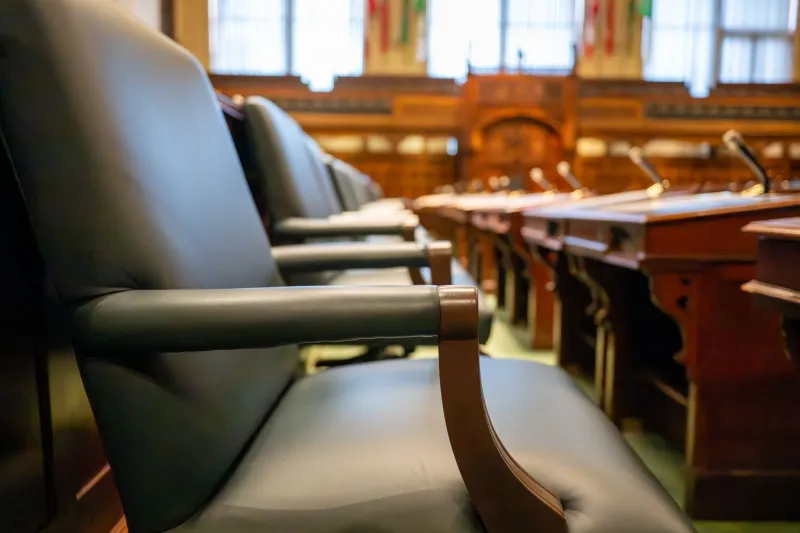
Because the lab leak has already happened. The variant is not in Washington. It is in the room with the bad chairs, the flickering projector and the agenda item about parking. Westminster keeps testing for presidents. Britain’s Trumpiest politics is being decided by 300 people and a show of hands.