The Four-Stamp Test: Britain's Trump Debate Keeps Failing on Brakes
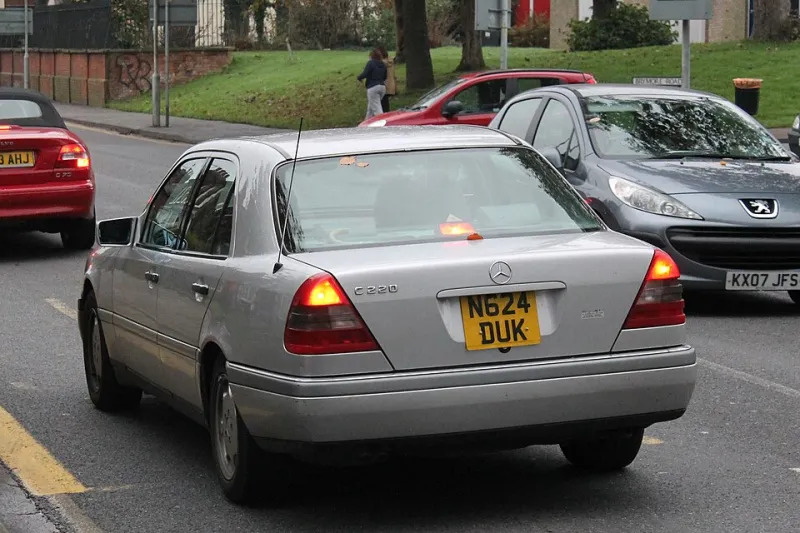
Photo: Charlie from United Kingdom, CC BY 2.0, via Wikimedia Commons
There is a garage on the ring road near you, and inside it a man who does not care about your feelings. He will not be moved by the fact that the car has never let you down, that you have owned it since 2011, or that your late father bought it and it still smells faintly of his dog. He puts it on the ramp, he looks underneath, and he tells you the truth. This is the MOT, and it is one of the last public institutions in Britain where sentiment counts for exactly nothing.
Westminster has no equivalent. A claim about Donald Trump arrives in the British debate roughly every eleven minutes, gets a panel segment, a phone-in, two columns and a hashtag, and at no point does anyone put it on the ramp.
So let us build one.
The Horn Is Fine. That Is the Problem.
The MOT-adjacent detail people forget is that the horn is one of the cheapest, easiest things to pass. Any idiot can wire a horn. Crank the volume, press the button, and the tester ticks the box. What fails cars is the stuff underneath: corroded brake lines, a caliper seized solid, a handbrake doing nothing but making a satisfying clicking noise.
British Trump discourse has spent a decade perfecting its horn. It is magnificent. It is loud, punctual, beautifully produced, and audible from space. Meanwhile the brake lines — what the claim actually means, who is making it, what it costs, when it ends — have quietly rusted through.
This is not a partisan observation, which is rather the point. The horn is pressed with equal vigour from every direction of the debate. It is the brake pedal that nobody in the commentariat seems to have located.
Four Stamps, One Certificate
A roadworthy claim needs four passes. Four, not forty. A tester who demands a hundred checks is not rigorous, he is just slow, and the queue backs up onto the bypass. Here is the short version.
Stamp One: Provenance
Where did this come from? Not 'where did you read it' — that is administration, not provenance. Who first said it, in what setting, and to whom were they speaking?
A great deal of what arrives in the British inbox turns out to be a screenshot of a screenshot, a clip with the first four seconds missing, a paraphrase of a quote from a speech about something else, or a document produced by an organisation with a name like the Institute for Applied Optimism and one anonymous funder in a filing cabinet.
You do not need to be paranoid to ask. You need a pen. Write down the origin. If the origin is 'someone said', write that down too, because it is useful to notice.
Stamp Two: Evidence
There is a difference — subtle, admittedly, in the age of the infinite scroll — between a thing that has been said and a thing that has been decided.
A podcast prediction is not a policy. A backbencher's wish is not a legislative programme. A briefing to a friendly outlet is not a signed instrument. Britain's debate routinely upgrades these the moment they cross the Atlantic, sometimes in the same sentence: 'Trump is reportedly considering, allies say…' becomes, by paragraph four, 'Britain faces…'
Evidence is a paper with a date. Vibes with a lanyard is not evidence, however well it dresses.
Stamp Three: The UK Cost Line
Every claim about Trump arrives with a hidden invoice attached. The test is simple: name the line item.
Does this land on a tariff schedule, a drug price, a defence commitment, a Northern Ireland arrangement, a visa queue, an interest rate? Or does it land on nothing much?
If the honest answer is 'nothing much', the claim is still allowed to be interesting, funny, alarming or all three. It is not allowed to be treated as an emergency with a deadline and a graphic. British households can only be braced so many times before they stop flinching, and the people who lose from that desensitisation are not the ones writing the columns.
Stamp Four: Expiry Date
The most neglected stamp in the whole garage. Every prediction should carry the date on which it becomes testable.
'Trump will…' is not a claim, it is a mood. 'By the end of the first quarter of 2027, this specific measure will have been published, and here is what it would do to this specific British industry' — that is a claim. It can be checked. It can fail. It can embarrass the person who made it.
A claim that cannot fail is not a bold prediction. It is a subscription service.
Advisories Are Where the Honesty Lives
British debate loves advisories — the little yellow note that says 'minor defect, monitor'. Advisories are the correct home for nuance: 'plausible but thin', 'direction of travel clear, mechanism unclear', 'would matter if the Senate agrees, which it might not'.
Most claims belong there. Almost none of them get there, because the format rewards failure: an advisory does not trend, and a dangerous defect does.
The Printable Fail Sheet
Cut this out. Keep it near the kettle. Apply to the next claim through the door, whichever direction it leans.
- Origin named, not paraphrased
- Speaker has the authority to do the thing
- Evidence is a document, not a mood
- UK cost line identified in pounds or in nothing
- Expiry date given, and it is before the next general election
- The opposite claim, when tested, passes the same checks
- This article's argument would survive the same test applied to itself
That last box is the one that separates a test from a shtick. Apply the sheet to something you wanted to believe, and see how it does.
Horn or Brakes?
None of this is an argument for cynicism. A brake inspection is not a complaint about the car; it is the thing that lets you drive it faster with confidence. A debate with working brakes can afford sharper arguments, bolder predictions and genuinely useful rows. One without them just makes noise at junctions, frightening the pedestrians and irritating the neighbours.
The horn is fine. The horn has always been fine. Britain's Trump debate now needs the other pedal, and someone with a clipboard, and the quiet professional cruelty of the man on the ring road who is about to tell you your handbrake has been decorative since spring.