The 2026 Midterm Petri Dish: Britain Is Studying the Wrong Sample
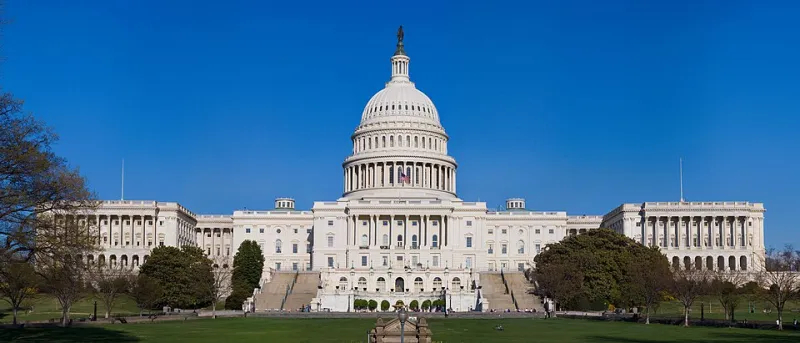
Photo: Noclip, Public domain, via Wikimedia Commons
America has voted, the 2026 midterms have landed, and Britain has done what Britain always does: grabbed a foreign result, held it up to the light and asked what it says about us. Within minutes of the first projections—and, on social media, several minutes before them—Westminster had converted a contest over congressional seats, state legislatures and local ballot measures into a national therapy session about British identity. The midterms are not a weather app for British politics. They are a weather app for American politics, with adverts for car insurance.
The result is in. The meaning is on back order.
The first thing to say is that the 2026 midterms were never going to produce a single clean verdict on Trumpism, whatever the more excitable graphics suggested. American elections are sprawling, local, contradictory and frequently decided by people who have strong views about potholes. Britain's commentariat, by contrast, prefers a tidy morality play with two acts and a villain. So a mixed result becomes a mandate; a narrow win becomes a landslide; a loss becomes a prophecy. The lab report would note a persistent methodological flaw: we are sampling American noise and labelling it British signal.
Westminster's American improv night
Watch a British politician respond to a US result and you can usually guess their domestic script before they open their mouth. For one side, every Republican advance is a warning that Britain must resist the politics of resentment. For another, every Democratic setback is proof that the elites are finally getting their comeuppance. For a third, any American outcome is evidence that Westminster is complacent, out of touch or both. None of these readings is necessarily wrong, but they are not really about Washington. They are about the NHS, small boats, net zero, tax, trans rights, university speech, the price of a pint and who gets blamed for it.
This is the great British midterm tradition: importing a foreign result and using it as a stick to beat a domestic opponent. It is cheaper than producing a policy and faster than reading a bill. The trouble is that it makes Britain sound like a country that cannot discuss its own future without asking Florida for permission.
Fleet Street's imported drug of choice
Fleet Street is not innocent here. The Telegraph, the Guardian, the Times, the Mail, the Express, GB News, the BBC and the entire ecosystem of podcasts, newsletters and angry men with ring lights all know that America sells. A US election gives you stakes, characters, weird signage and the delicious possibility that a British reader will feel morally superior for at least four paragraphs. The result is a form of political pornography: everything is vivid, nothing is accountable, and the consumer is left with a vague sense of having participated in democracy without ever leaving the sofa.
Social media sharpens the trade. A clip of an American politician saying something outrageous travels further than a select committee report on procurement. A US culture-war skirmish can dominate British trending topics for days, even when the British equivalent is a council meeting about bin collections. We are not short of opinions about America. We are short of filter.
The test Britain keeps failing
The sharper transatlantic test is not 'whose side are you on?' It is: what does this actually change for Britain? A US midterm result might affect tariffs, defence procurement, intelligence sharing, climate finance, tech regulation, the Northern Ireland protocol, the Chagos arrangement or the price of borrowing. Those are material questions. They deserve scrutiny. But most British commentary does not linger on them because they are complicated and do not fit into a culture-war meme.
A second test is mechanism. If a Republican win in Ohio is supposed to explain why Labour is losing a by-election in Hartlepool, the argument needs a mechanism, not just a vibe. Does the US result change British public opinion? Does it change party funding? Does it change the global economy? Or does it merely give a British commentator a new adjective? Often it is the last one.
A third test is consistency. Britain is happy to diagnose American democratic dysfunction while treating its own constitutional oddities as charming. We cannot import the language of constitutional crisis when our own settlement is held together by convention, a vague ministerial code and the willingness of the Speaker to shout. This is not a reason to ignore America. It is a reason to stop using America as a mirror that flatters us.
A sharper transatlantic exam
Here is a better way to read the 2026 midterms. First, separate the federal from the local. Congress matters for trade, defence and foreign policy. State legislatures matter for abortion, education and energy, but their direct effect on Britain is limited. Local ballot measures matter enormously to Americans and almost not at all to a voter in Swindon. Second, separate signal from spectacle. A shift in suburban swing seats may tell us something about the American centre. A viral row about a school library may tell us something about the American media, not the American electorate. Third, ask who benefits from the British framing. If a story is being used to attack Keir Starmer, Kemi Badenoch, Nigel Farage or the BBC, it is probably doing domestic work.
None of this requires Britain to be neutral about American politics in the sense of having no views. It requires us to be honest about which views are ours and which are borrowed. Trump-era politics is not a single exportable ideology. It is a coalition, a style, a grievance network and a media machine. Britain has its own versions of all four. We do not need to wait for a US election result to notice them.
The control group Britain never uses
The experiment is simple. Pick one American result from the 2026 midterms. Follow it for a week. Note every time a British commentator says it proves something about Britain. Then ask: would this argument still work if the result had gone the other way? If yes, it is not analysis. It is a Rorschach test with a flag.
The lab report, then, is not that Britain is obsessed with America. It is that Britain is obsessed with using America to avoid an argument with itself. The midterms are over. The American voters have had their say. British commentators have had several. The useful question is not what America decided, but what Britain is determined not to decide. Until we answer that, every US election will be treated as a British by-election with better graphics.